
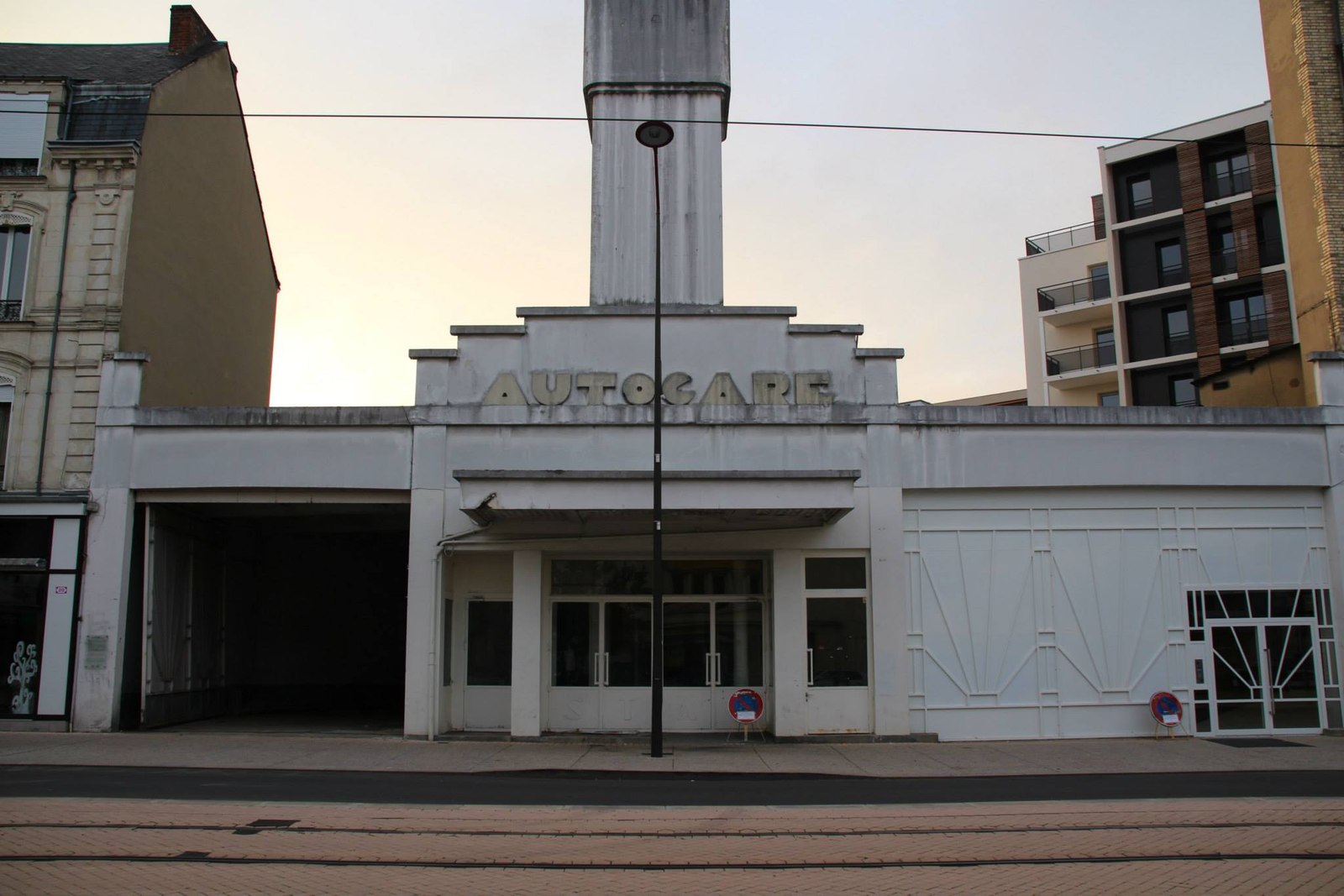
Photo : Chroniques urbaines, CC BY-SA 4.0, via Wikimedia Commons
Autogare de la STAO
Le Mans bus station, listed as a historic monument, representative of the historic transport network of western France.
What's on
Nothing announced here for now.
Practical info
Tram
Lines T1, T2 — Préfecture stop, 100 m · wheelchair-accessible stop
Bus
Line 5 — Préfecture stop, 100 m · wheelchair-accessible stop
Parking
Parking right in front (paid, surface lot)
Data: SETRAM / Le Mans Métropole (GTFS, Open Licence), © OpenStreetMap contributors (ODbL)
More about Autogare de la STAO
The STAO bus station is an Art Deco architectural ensemble in Le Mans, now listed as a historic monument. It is not “visited” the way a museum is: it is urban heritage best viewed from the street, especially its white reinforced-concrete facade, its rotunda topped by a concrete dome set with glass tiles, and its side corridors for arrivals and departures, also covered with concrete slabs with embedded glass. According to several descriptions, the monumental entrance evokes the pediment of an old Hollywood cinema.
The building is now private. Since it was bought by a property developer, the rear of the site has been demolished to make way for a residential project (“Patio-Rivoli”), while the protected facade, dome, rotunda and corridors (about 500 m²) have been kept and integrated into the project. It is a spot appreciated by Art Deco enthusiasts, right next to the SNCF train station.
A bit of history
Built in 1935 by the Société des transports automobiles de l'Ouest (STAO), the bus station was for decades the only arrival and departure terminal for intercity coaches in the Sarthe network, until a multimodal hub opened at the SNCF train station in July 2013, which led to its abandonment. The operating company, STAO, belonged to a transport group that later became Verney and then Connex. At the time of its protection, the building belonged to the Compagnie générale des transports Verney.
On October 10, 2008, the building was listed as a historic monument. The protection covers the facade on avenue du Général-Leclerc and its roof, the two arrival and departure corridors with their glass-set concrete structure, the rotunda and the adjoining bay. After the site was abandoned, the “Patio-Rivoli” project led to the demolition of the rear of the building to build about thirty homes, while the protected elements were kept.