

Photo : Sortir au Mans
Cathédrale Saint-Julien
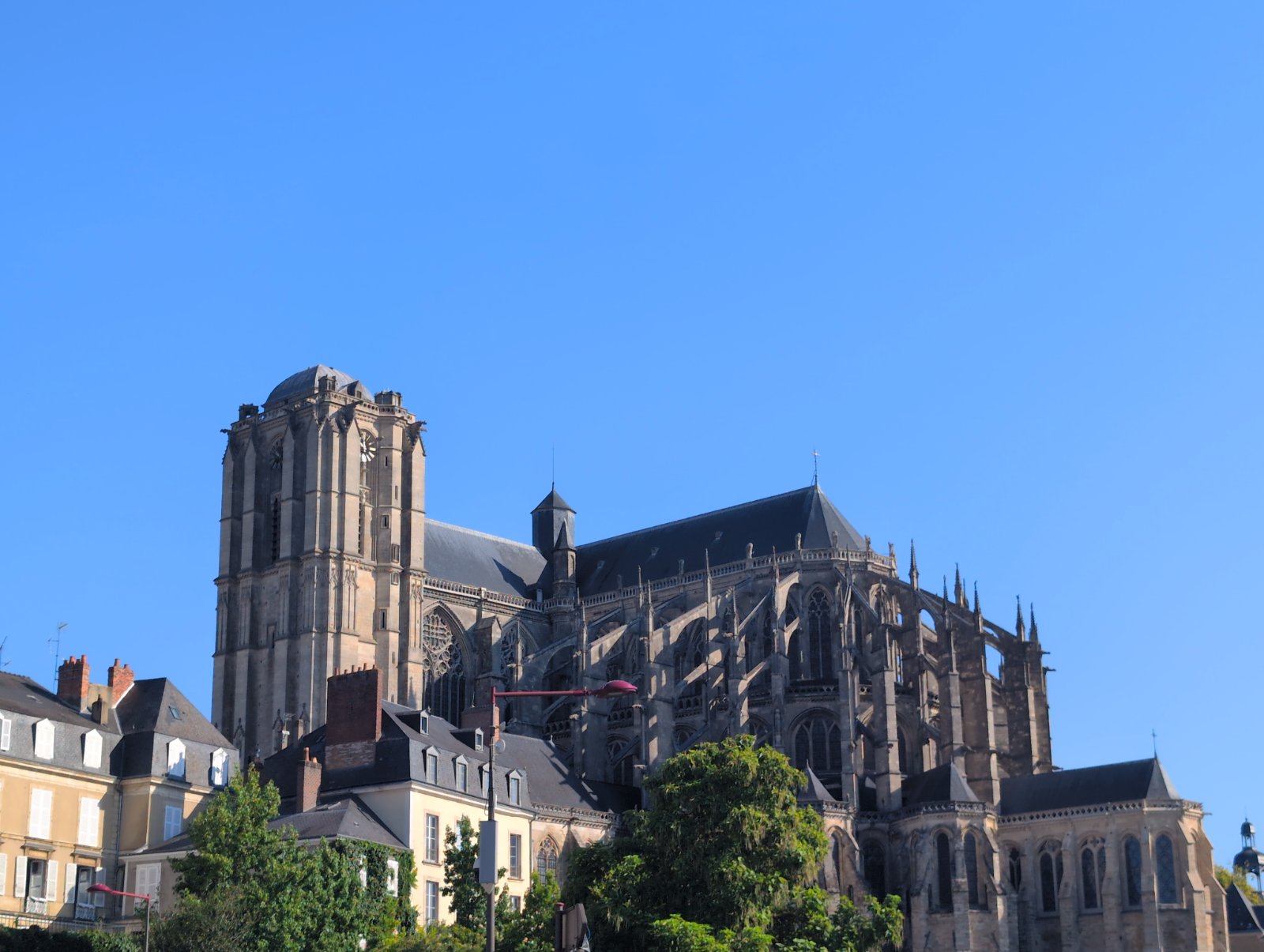
Gothic-Romanesque cathedral, the emblem of Le Mans and seat of the diocese, a remarkable example of Angevin Gothic architecture. Located on Place des Jacobins, reachable by tram line 2.
What's on
Nothing announced here for now.
Practical info
Tram
T2 — Jacobins-Quinconces stop, 130 m · wheelchair-accessible stop
Bus
Lines M, 8 — Mendès France stop, 90 m · wheelchair-accessible stop
Parking
Parking 80 m away: Parking des Jacobins (paid, 388 spaces, underground)
Data: SETRAM / Le Mans Métropole (GTFS, Open Licence), © OpenStreetMap contributors (ODbL)
More about Cathédrale Saint-Julien
Saint-Julien Cathedral is one of France's largest Gothic buildings, measuring 134 meters long and covering 5,000 m². Its tower rises 64 meters, making it the tallest structure in the Le Mans area. Together with Chartres Cathedral, it houses one of the finest surviving medieval stained-glass ensembles in France, as well as a masterpiece of Western Gothic painting: the “Heavenly Concert” of 47 angel musicians painted on the vaults of the Lady Chapel. The cathedral also contains tomb effigies, a monumental organ case, choir stalls, and a contemporary sculpture of Christ by goldsmith Goudji, installed in 2014.
Still an active parish, the cathedral holds regular Masses (the Maîtrise de la Cathédrale provides the sung celebrations), “musical hours” organ recitals, and guided tours organized by the Le Mans Tourist Office. It is practically a must on any visit to the Old Town, just above the Gallo-Roman ramparts.
A bit of history
Construction began around 1060 under Bishop Vulgrin, on a new site facing the city's north rampart. The initial building partially collapsed within the following decade. Bishop Arnaud resumed the work in 1067, the choir and crypt were completed in 1081, and then Bishop Hoël brought in Norman builders. The cathedral was open to pilgrims as early as October 17, 1093. Bishop Hildebert de Lavardin oversaw its completion around 1120, and Guillaume de Passavant dedicated the building on April 18, 1158.
Starting in 1220, a new Gothic choir with thirteen radiating chapels replaced the old choir, judged too dark and too narrow. Bishop Geoffroy de Loudon launched this major rebuilding, to which architect Jehan de Chelles (also active at Notre-Dame de Paris) contributed. The new choir, ten meters taller, was completed in April 1254. Between 1385 and 1430, architect Jehan le Mançon raised the transept and nave to match the height of the choir. The Hundred Years' War interrupted the work, but the north arm of the transept was completed around 1430, giving the building its nearly final form.