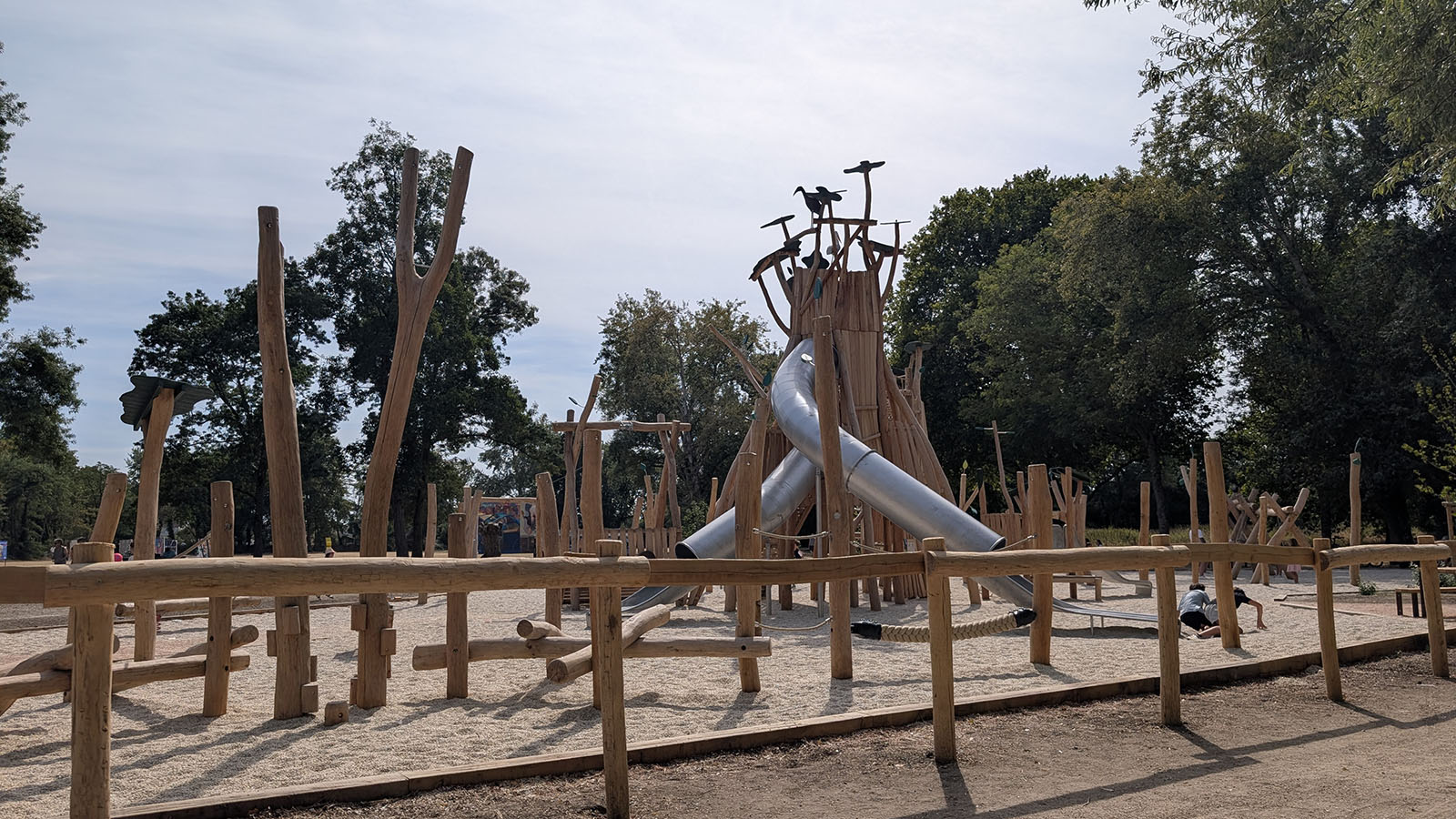
Photo : SortirAuMans, août 2026
Parc Gué de Maulny
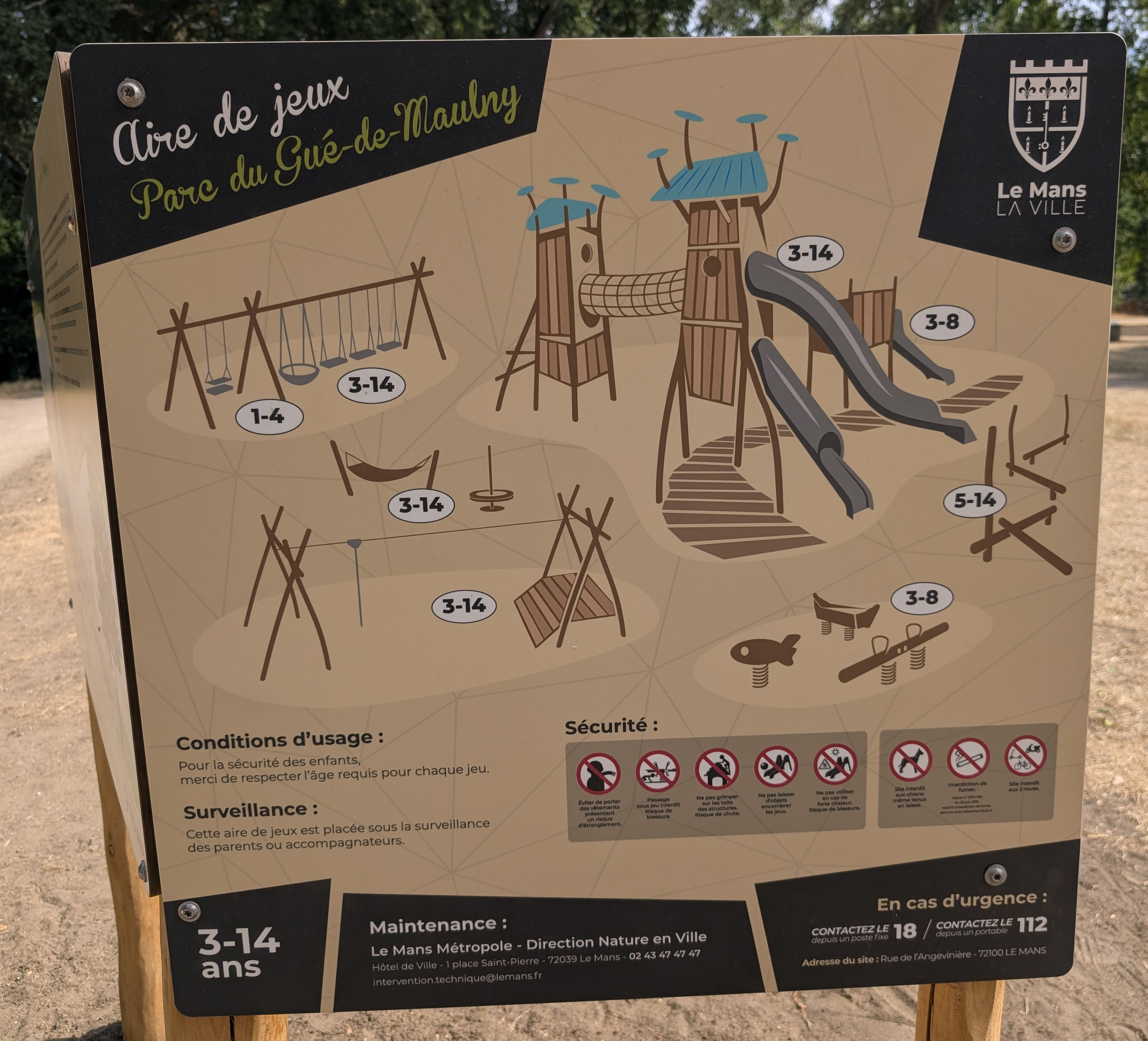
Large park on the banks of the Huisne, near the Gare Sud train station, with “La Mangrove,” a wooden adventure play area for ages 3–14.
What's on

Practical info
Hours
Open 7 days a week, 24 hours a day (free-access neighborhood facility)
Access
Entrance on rue de l'Angevinière (72100 Le Mans), second access on the Gare Sud side. A footbridge crosses the Huisne to the meadow. The “La Mangrove” play area is free to access, with sandy ground.
Tram
Lines T1, T2 — Gares stop, 600 m · wheelchair-accessible stop
Bus
Lines T3, 13 — Pêcheurs stop, 250 m · wheelchair-accessible stop
Data: SETRAM / Le Mans Métropole (GTFS, Open Licence), © OpenStreetMap contributors (ODbL)
More about Parc Gué de Maulny
Gué-de-Maulny Park is a 16.5-hectare public green space in Le Mans, between the Gare Sud train station and the ring road, in the southwest of the city on the banks of the Huisne. A free-access neighborhood facility, it has picnic tables, benches, a children's play area and a multisports space, making it a favorite relaxation spot for local families. A footbridge crosses the Huisne to a meadow where you can watch ducks along the riverbank, and dogs are welcome.
Since 2018, the park has hosted an urban arts festival every year that mixes music and street art murals, helping give the site a cultural identity again. The redevelopment led by Le Mans Métropole also upgraded the multisports field and redid the entrance on the Gare Sud side.
Its new play area, “La Mangrove,” comes from the park's location at the confluence of the Huisne and the Sarthe: a floodable site in constant contact with water. The city drew on that to create a tropical forest theme, with trees that grow with their roots in the water and whose big roots intertwine into a labyrinth, sheltering birds, fish and insects. Natural wood, ropes, foliage and immersive sets make up an adventure course where kids climb through branches, cross suspension bridges, slip between roots, look out from the lookout towers and zip along the zipline. A discreet treasure hunt awaits kids: count the colorful birds hidden in the structure.
The area is for ages 3–14, with a swing section open from age 1, and each piece of equipment is marked with the age it is meant for. Children must be supervised by parents or caregivers.
A bit of history
The site has been a crossing point since ancient times: as early as the Gallo-Roman period, the Gué de Maulny ford was a major route around Le Mans, and in the Middle Ages it became an important passage toward Arnage and the Huisne valley, leading to Pontlieue. The Valois family had a country château built there, the “château du Gué-de-Maulny,” which remains in history as the birthplace of the future King of France, Jean II the Good (1319–1364), who reigned from 1350 to 1364. In 1359, during the Hundred Years' War, English troops marching on Le Mans destroyed the château and the adjoining chapel, forcing the clergy to retreat toward the city center. A collegiate chapel with the same name, moved to Place du Hallai, was not finally demolished until 1743.
In the industrial era, the city of Le Mans bought mills on the site in 1862 that harnessed the power of the Huisne. These mills were converted into water treatment facilities between 1900 and 1907, before being abandoned for lack of capacity, with the activity moved to L'Épau. The ford itself was replaced by a wooden bridge in 1872, then by a new footbridge installed by the city in 1987, after the site was fully absorbed into the urban fabric of today's park.
Venue map